Being a creative now is not as easy as it used to be.
Because every time you think there’s no more tools to be built, someone decides to build another AI tool that does what you do.
One that can write faster than you, design better than you, or edit videos in minutes instead of hours.
So it’s normal if you’ve asked yourself this question at least once:
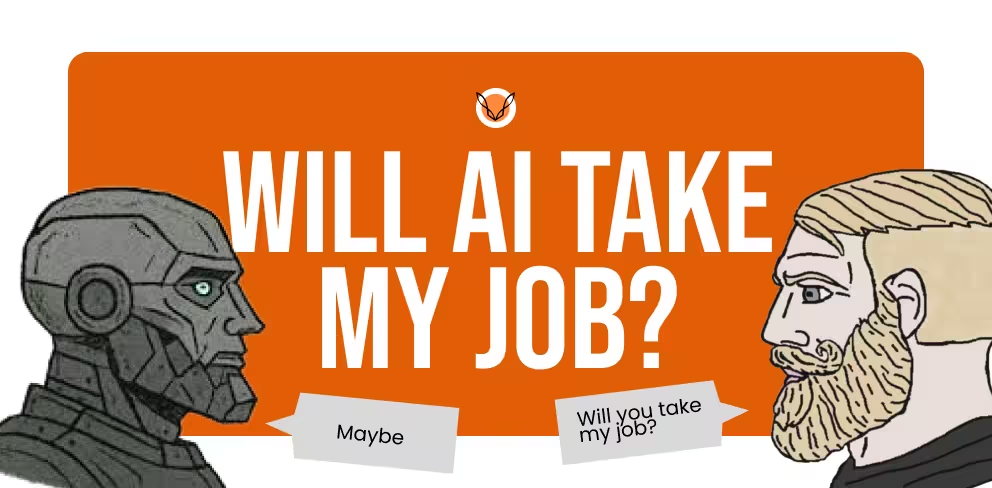
Will AI take my job?
And it’s not just you that’s asking, every other designer, writer, marketer, video editor, developer, and even people outside tech are asking the same thing.
And honestly? The fear makes sense.
A recent research shows that more than half of workers globally now believe AI could significantly change or replace parts of their job.
Not even in some far-off future, but within the next few years, and that alone is enough to make anyone pause.
We now have AI that can do tasks that used to take humans days to finish. In some cases, it does them faster, cheaper, and sometimes… better.
So no, this isn’t one of those articles that will tell you, Relax, AI won’t affect you at all.
That’s not true.
But it’s also not as simple as AI replacing everyone. Because what AI is really changing is not jobs, it’s tasks.
And the people who will struggle the most are not creatives themselves, but creatives who refuse to adapt.
This article is not about panic; it is about clarity.
So instead of just asking, Will AI take my job?
Maybe the better question is.. How do I stay relevant in a world where AI is everywhere?
Let’s talk about it.
AI Is Not Coming, It Is Already Here.
The honest and visible truth is that…
AI is not some future idea we are preparing for; it is already part of how work gets done today.
Most creatives are already using AI, whether they openly admit it or not.
↔ Designers use it to explore ideas faster.
↔ Writers use it to get past blank pages.
↔ Video editors use it to speed up editing, captions, and cleanup.
↔ Developers use it to debug, document, and ship faster.
In fact, most people interacting with AI are not using it to replace their work; they’re using it to move faster.
And the numbers back this up.
Recent studies show that about 58% of employees now use AI tools regularly at work, and many of those say it actually saves them time, often freeing up 1.5 to 2.5 hours per week by handling repetitive tasks like writing drafts, summarizing notes, or organizing data.
For some people, that’s extra time to rest.
For others, it means taking on more work, more clients, or higher expectations.

Either way, AI has already changed the pace of work.
What used to take days can now be done in hours, and what used to take hours can now be done in minutes.
This is why the conversation around AI feels so intense.
Of course, not because AI is perfect, but because it’s useful. And once a tool becomes useful, it doesn’t go away.
↔ Companies are already adjusting expectations.
↔ Teams are expected to move faster.
↔ Output matters more.
And the gap between people who know how to use these tools and those who don’t is getting wider.
So when we ask, Will AI take my job?
What we’re really asking is…What happens to my role now that AI is part of the workflow?
And to answer that properly, we need to talk about adaptation because this is where the real divide starts.
Adapt or Get Replaced
This might sound harsh, but it’s already happening.
The people losing relevance are not the most talented creatives; they’re not even the least talented ones.
They’re the ones doing things the same way, while the tools around them change.
AI does not wake up and decide to take someone’s job; what actually happens is simpler.
↔ A company realizes that one person who knows how to use AI can now do the work of two or three people.
↔ A freelancer who uses AI can deliver faster and cheaper.
↔ A creative who understands the tools can experiment more, iterate faster, and ship better work.
Over time, the gap shows.
This is not because AI replaced anyone directly, but because someone else adapted.
This is why adaptation matters more than talent right now.
Knowing how to use AI is quickly becoming a baseline skill, not a special advantage. Just like knowing how to use Google, Photoshop, or Excel at some point became expected.
And this doesn’t mean you hand everything over to AI.
It means you learn where it helps, where it doesn’t, and how to stay in control of the outcome.
The creatives who will survive this shift are not the ones fighting AI.
They are the ones building with it and use AI to speed up the boring parts. They keep the thinking, taste, judgment, and decision-making for themselves.
Because at the end of the day, tools don’t get hired, people do.
And next, we need to look at how this plays out in real roles, starting with designers.
Case Study: Designers in the Age of AI
Designers were one of the first groups to feel the impact of AI.
Today, a simple text prompt can generate logos, illustrations, brand visuals, and even full scenes in minutes.
Tools like image generators can produce multiple styles at once, all from the same idea.
On the surface, this feels threatening.
If a client can type a few words and get decent visuals, the obvious question becomes, Why hire a designer?
But here’s what often gets missed.
AI doesn’t understand brand context, audience, or intent. Designers still decide the direction, refine the output, and choose what actually works.
AI speeds up the process, but taste and judgment are still human.
Case Study: Video Editors in the Age of AI
Video editors are feeling the pressure just as much.
AI tools can now generate videos from text, apply transitions, add subtitles, clean up audio, and even color-grade footage in minutes.
On the surface, this feels threatening.
If AI can handle cuts, effects, and edits automatically, the obvious question becomes: Why hire a video editor?
But the thing is…AI doesn’t understand the story, pacing, or emotion behind a video.
Editors still decide what to cut, what to keep, and why it matters.
AI speeds up the workflow, but storytelling and creative judgment are still required to be done by a human.
Case Study: Writers in the Age of AI
Writers were also hit early by AI tools.
Today, AI can write blog posts, tweets, scripts, and summaries in seconds. If AI can produce content instantly, then where is the need to hire a writer?
But here’s the gist…
AI can generate words, but it doesn’t have lived experience, clear intent, or a real voice.
Writers are still needed to shape meaning, flow, and resonance.
Where AI Still Falls Short
No doubt, AI is impressive.
It can generate ideas, mimic styles, and automate tasks.
But there are still things it can’t fully replace.
↔ AI doesn’t have context beyond what it’s given.
↔ It does not understand why something matters, only how to produce it.
↔ It does not have taste, intuition, or real-world experience.
Most importantly, AI can create output, but it can’t take ownership.
↔ It can’t stand behind decisions.
↔ It can’t be accountable for results.
↔ And it can’t prove that it actually did the work in a meaningful way.
This is where things start to matter a lot more, especially in web3.
Because in a world filled with AI-generated content, copied styles, and automated work, proof becomes the differentiator.
And that leads us to something AI still can’t fake: on-chain proof of work.
AI Can’t Replace Onchain Proof
AI can’t fake what you’ve deployed, contributed to, what you’ve earned, shipped, or interacted with on-chain.
And in Web3, your actions leave a trail.
↔ You either deployed the contract or you didn’t.
↔ You either contributed or you didn’t.
↔ You either earned the reward, or you didn’t.
Everything is visible, verifiable, and once it is on-chain, it’s permanent.
This is why on-chain proof matters even more in an AI-heavy world.
When timelines are flooded with AI-generated content, copied ideas, and recycled thoughts, verifiable work becomes your edge.
↔ Your wallet becomes your resume.
↔ Your transactions become your track record.
↔ Your on-chain history shows what you’ve actually done, not just what you say you can do.
And maybe that’s the shift most people are missing.
AI is making it easier to say things, but Web3 makes it harder to fake doing things.
So instead of competing with AI on output alone, the real advantage is building, contributing, and leaving proof that you showed up and shipped.
And that brings us to the most important part of this conversation.
So, What Should You Do Now?
The first thing to understand is this: AI is NOT going away.
It will keep getting faster, smarter, and easier to use.
So you have two choices:
➛ Ignore it and risk being left behind.
➛ Learn to use it, and let it amplify your work instead of replacing it.
Learning AI doesn’t mean handing over your creativity.
It means using it to speed up repetitive tasks, explore ideas faster, and make better decisions.
Most importantly, let your value live on-chain.
Ship work, contribute, and make your proof visible. That’s what lasts when everything else is automated.
AI will replace some jobs. That’s true.
But it won’t replace people who know how to build with it and show what they built.
Let’s Wrap This Up
So, will AI take your job? Maybe.
This is dependent on how you respond to the changes happening now.
If you ignore AI and stick to old ways, it will replace parts of your role.
If you learn to use it, let it amplify your work, and show proof of what you’ve built, it becomes your advantage.
The future favors those who adapt, build, and make their contributions visible.
Your skills, judgment, and creativity are still your strongest assets; AI can’t replace that.
The question is not just Will AI take my job?
It is How will I stay relevant and irreplaceable in a world where AI is everywhere?